
White House Sports Roundtable
- Andrew
- Mar 12
- 6 min read
The Roundtable to Save College Sports Won’t Save College Sports
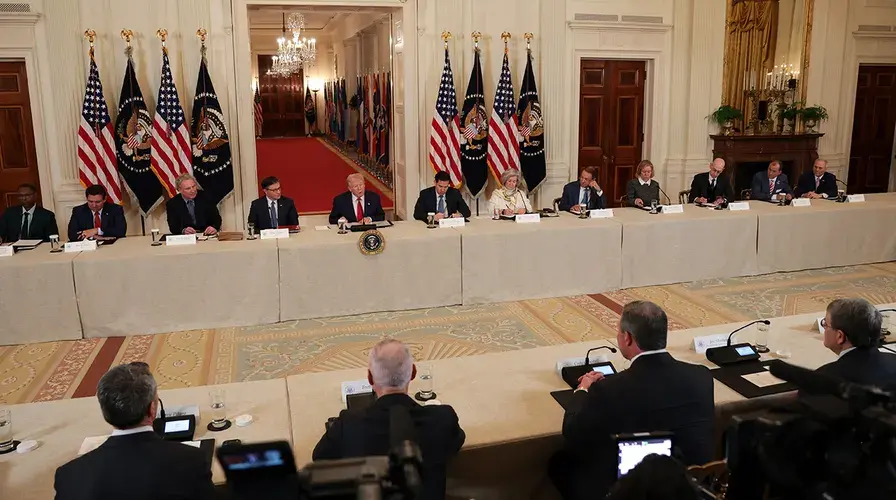
Last week, President Donald Trump and other federal lawmakers hosted a roundtable at the
White House to explore “saving” college sports in America. The president concluded the
meeting by stating that he will issue an executive order in the coming weeks to attempt to reset the college sports landscape back to the way it was before name, image and likeness, a.k.a. NIL, compensation came to be. Many top industry names and stakeholders were present, including NCAA president Charlie Baker, NBA commissioner Adam Silver, Nick Saban, Urban Meyer, among others. Also present were other government officials, including Secretary of State Marco Rubio, Speaker of the House Mike Johnson, and Senator Ted Cruz.
With all of the star power and big names present, little realistic steps were taken to “save”
college sports. Why you might ask? Because the focus of the discussion and prospective
solutions were not in alignment with the legal realities of reforms that can survive judicial
scrutiny, and the persons most impacted by the intended reforms were not in attendance:
college athletes.
Lawmaking is sausage-making. You don’t want to see how it’s made and you may not
understand how it’s made, yet it produces a final product. But how palatable that final product is can vary widely. Congress is currently considering legislation to “save” college sports, but given how unproductive and paralyzed Congress is to pass anything, the probability of Congress actually passing anything for the president to sign into law is extremely low. Which is where the president’s executive order comes in. Presidents often sign executive orders when Congress is unable to pass legislation to address a perceived problem. The limitations of executive orders are that they are much less likely to survive court challenges and the next president can simply sign an executive order that reverses their predecessor.
Why Is Any of This Necessary?
In 2021, the Supreme Court issued an opinion in NCAA v. Alston, which held that the NCAA
violated the federal Sherman Anti-Trust Act. Without getting too far in the legal weeds, the
practical effect of this ruling removed NCAA restrictions on compensation for athletes based on their name, image and likeness. Ours being a market-based economy, college athletes financially compensated for using their platforms to cash in is now the reality the college sports industry lives in.
In the five years since the Alston ruling, compensation for college athletes has skyrocketed.
Some estimate that top college football teams are now spending close to $40million on rosters – former LSU football coach Brian Kelly recently alleged on SiriusXM show “Dusty and Danny In the Morning” that current coach Lane Kiffin has $40million committed for LSU’s 2026 roster. It is estimated that this year’s Kentucky men’s basketball roster is collectively paid about $22million. These figures are only going to rise as the pressure on coaches to win will only intensify over time. Coaches must win or they will get fired.
What Country Is This?
I recently had a conversation with a friend about college athletes making money. His opinion is that a college scholarship is sufficient compensation and players should not make money beyond a scholarship. I disagreed. My oft-stated reply is “What country is this?”
We live in the good ole’ USA and we have a market-based economy. Generally, in our economy, participants are not permitted to implement unlawful restraints of trade. If willing buyers and willing sellers want to contract with each another, they are free to do so. I hope college athletes make money. A lot of money. I will never stand in the way of another person improving their financial standing in life, as long as it is not harming someone else in the process.
A Realistic Solution: Collective Bargaining
The days of the NCAA unilaterally passing rules that restrict the rights of college athletes are
over. And given the Supreme Court has already ruled the NCAA violated the rights of college athletes, why would it uphold similar restrictions enacted by Congress or by presidential executive order? It won’t.
Congress can pass legislation and the president can sign an executive order, but in my opinion, either option is not likely to survive judicial scrutiny.
But what will?
Collective bargaining.
If there were a collective bargaining agreement, a.k.a. a CBA, entered into by college
administrators and college athletes to produce negotiated terms regulating each side, this
would survive court challenges. If each side agrees to the rules and terms of a CBA, they can’t then run to the courts to challenge terms that they already agreed to. The terms of the CBA would be binding. Professional sports leagues have operated under collective bargaining agreements for decades.
College administrators are on balance opposed to CBAs. A CBA would result in college athletes being deemed employees of the schools. It would result in direct compensation based on time and work performed like any other employee on a college campus. Would college athletes still be required to be students given their nexus to the school would shift to being an employee of the institution? Some doomsdayers argue a CBA would obliterate the “student athlete” categorization. However, I would argue that other students on campus are also employees of the school in other capacities, and the more vivid reality is that we crossed this “post student athlete” bridge many years ago given the amount of money and out-sized impact of college sports.
A Bigger Problem
In my opinion, a bigger problem than NIL compensation is the lack of guardrails for transferring between schools. College basketball broadcaster Jay Bilas often rails against NCAA rules placing restrictions on college athletes. He usually says something like, “Regular students that are not playing sports can transfer yearly to different schools, so why can’t student that is an athlete also transfer to another school each year?”
I like Bilas and agree with a lot of what he has to say on things college sports, but some
guardrails and predictability is warranted. There are deleterious effects on the landscape of
college sports for players to play at four different schools in four years. The fan experience of
relearning rosters every single year is not good for the health of the sports. Part of why we fell in love with sports as young people is connection to players developed over multiple years. Learning their biographies, interests off the court, and watching them develop as players and people over multiple seasons is how we as fans learn about the players as people.
Collateral Damage
All of the above notwithstanding, the shifting college sports landscape has and will continue to cause collateral damage. And frankly, I do not know the answers for the ripple-effects to come.
There are about 1,100 member-schools in the NCAA. It is generally understood that only 2
sports are profitable in the college sports industry: football and men’s basketball. (A few
outliers are in women’s basketball and baseball, but not many.) Additionally, all college athletic departments outside of what we know as the “Power Five” conferences (including the Big East conference for basketball) lose money on college sports. Even power conference teams are losing money – Big Ten-member Rutgers recently released an audit showing its athletic department ran a deficit of $78million in the 2024-2025 academic calendar year.
If most NCAA member-colleges are already losing money on sports, how can they absorb this new expenditure for compensation to the athletes? For some schools, difficult decisions will be made, including cutting some sports, reducing scholarships, and even self-relegation to lower divisions that do not require athletic scholarships. Last year, St. Francis University made the NCAA men’s basketball tournament, and shortly thereafter announced that it is moving from Division I to Division III in 2029 because it cannot sustain the rising costs of participating in Division I. More of that will come.
The House lawsuit settlement is another column altogether, so I won’t touch that in this piece.
All this to say: I am not convinced college sports needs “saving,” and whatever problems are
warranting redress, the power players from the president on down are not pursuing the path or plan to achieve a lasting, sustainable resolution. Until all stakeholders are at the negotiating table, the wild, wild west of modern college sports is here to stay.
Comments